DRAVYAGUNA
Shatavari
Asparagus racemosus — Queen of Herbs · शतावरी
| BOTANICAL NAME | Asparagus racemosus |
| SANSKRIT | Shatavari · शतावरी |
| FAMILY | Asparagaceae |
| PART USED | Tuberous root |
| CLASSICAL TEXTS | Charaka Samhita · Sushruta Samhita · Bhavaprakasha Nighantu |
| DOSHA ACTION | V↓ · P↓ · K↑ |
| RASA · VIRYA · VIPAKA | Sweet, bitter · cooling · sweet |
| PRIMARY USE | Female rasayana — stri rasayana |
Western herbalism has no real word for what Shatavari does. The closest is "adaptogen," but adaptogens act on stress. Shatavari acts on the female body itself — across cycles, across decades, across the long passage from menarche through perimenopause and beyond. The classical texts call it the Queen of Herbs.
01 · The plant
Shatavari is the Queen of Herbs — shata-vari, "she who has a hundred roots." The plant grows wild across the Himalayan foothills and the dry forests of central India; the medicine is in the root, which fans out beneath the soil in a cluster of finger-like tubers. A mature plant carries dozens. The same herb prescribed by a Kerala Vaidya in 2026 was prescribed by a Varanasi Vaidya in 800 CE. Two thousand years of clinical use, for the same set of indications.
02 · In the texts
Bhavaprakasha — the sixteenth-century materia medica — names Shatavari the principal stri rasayana, the rejuvenative herb for women. Charaka, eight centuries earlier, places it in the Vajikarana group: the formulas that build vitality and reproductive tissue. Sushruta uses it for recovery after childbirth and for what the texts describe as the falling away of rasa dhatu — the fluid tissue that underlies the others — as a woman moves through her forties and fifties.
The classical indications cluster around three life-stages.
Menarche to early adulthood — to support the developing reproductive system and to build shukra dhatu, the tissue the body draws on when it is asked to work hard.
The childbearing years — fertility, conception, lactation, recovery after birth.
Perimenopause and after — the heat that rises (the flushes, the night sweats, the dry skin, the mind that won't settle), and the substance that is leaving. Shatavari is the classical answer to both, given for years rather than weeks.
The herb has further uses outside the female-specific context — for the gut, the lungs, the heart, the immune system — but its principal classical position is stri rasayana.
03 · In the formulary
Shatavari runs through the Herveda and MyVeda system as a connecting thread. It appears in more places than any other category-specific herb in the range.
The two Herveda blends
Shatavari sits at the heart of two Herveda Samyoga formulas, each carried by a complex of cold-pressed oils chosen for what the dosha needs.
Yoni Lunar — the delicate skin serum.
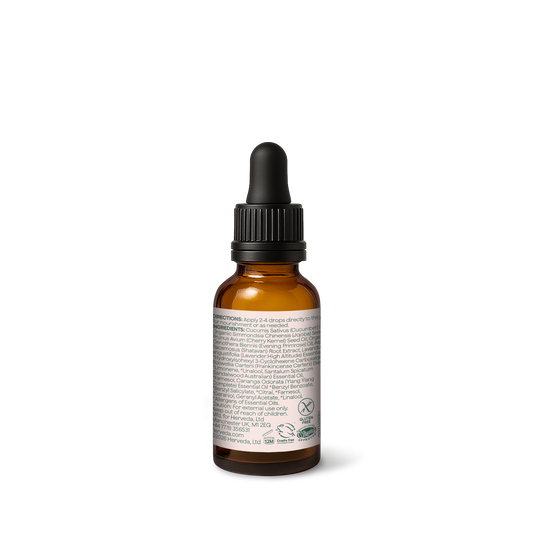
A lightweight botanical serum for delicate external skin. Organic Shatavari root is infused into a base of cold-pressed cucumber seed, organic jojoba, organic evening primrose, and organic cherry kernel oil — a combination of cooling and bio-identical lipids that absorbs without heaviness. The aromatic structure is held to a precise 0.5%: Australian Sandalwood, Frankincense Boswellia Carterii, high-altitude Lavender, and organic Ylang Ylang.
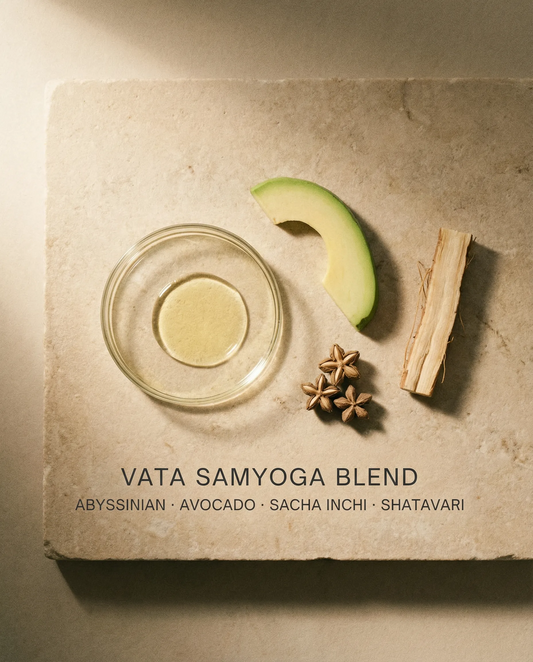
Sanchara Glow — the Vata face oil.
Shatavari root is infused into Abyssinian, organic avocado, and organic sacha inchi — three oils chosen for the Vata face: Abyssinian for its silken slip, avocado for its weight on dry, fine-lined skin, sacha inchi for its omega-3 content and its lightness. The aromatic is built on neroli and petitgrain mandarin — a Mediterranean-citric register that lifts the mood without warming the face.
The maceration ritual
The Shatavari root is infused into the carrier oils for twenty-four hours at thirty-seven degrees — body temperature. The temperature is held low and steady to preserve the subtle properties of the root, which heat would dismantle.
For the duration of the maceration, Maharishi Gandharva Veda plays in the room.
Gandharva Veda is the classical music of the Vedic tradition — raga tuned to the time of day, performed continuously, on the principle that sound and substance meet. The classical Vaidya understanding is that a medicine is not only its molecules; it is also the conditions in which it is prepared. Every batch of Yoni Lunar and every batch of Sanchara Glow is hand-blended this way, in small batches, in the UK.
The MyVeda 12
MyVeda is our US classical-Ayurvedic supplement line, distributed in the UK by Herveda. The formulas are written by Vaidya Manohar Palakurthi (BAMS, PhD; trained under Vaidya Balraj Maharishi, Rajvaidya Brihaspati Dev Triguna, and Vaidya V.M. Dwivedi) and manufactured by Sreedhareeyam Farmherbs in Kerala under Class 100 clean-room and NABL-laboratory protocols.
Shatavari appears in nine of the twelve.
| Formula | Shatavari's role |
|---|---|
| VitalVeda 46 — daily rasayana | Shatavari with its sister Asparagus adscendens — the female-rejuvenative axis of the medhya group |
| GutVeda 55 — digestion | Cooling and demulcent; soothes the gut lining |
| RestVeda 32 — sleep | Calms the inner heat that disturbs sleep |
| CalmVeda 23 — worry, mental clarity | Emotional calm via the Mind:Body axis |
| UnwindVeda 52 — mood, mental balance | Mental stress, hormonal equilibrium |
| DigestVeda 28 — acidity | Cools and rebuilds the gastric mucosa |
| UpliftVeda 41 — emotional lift | Stabilising; emotional resilience |
| EnergyVeda 26 — vitality, stamina | Rejuvenates shukra dhatu; supports endurance |
| ImmuneVeda 76 — immunity, prana | Rasayana action; cools and replenishes |
Three other herbs in the MyVeda formulary appear in more places — Amla and Indian Tinospora in eleven each, Bael in ten — but each of those is a tridoshic generalist that classical practice places at the foundation of almost any formula. Shatavari is different. It is a category-specific herb — a stri rasayana — and yet it shows up in nine of twelve. The reason is that the indication it answers underlies the architecture of women's health across most of the conditions a modern woman actually presents with.
Ayurvediq Shatavari
For women who want the herb internally, Herveda stocks Ayurvediq Shatavari — a classical preparation, taken once or twice daily, traditionally with warm milk in the evening (milk being the Ayurvedic anupana, the carrier that brings Shatavari into the deeper tissues).
The internal route and the external route work together. Yoni Lunar and Sanchara Glow on the skin; Ayurvediq Shatavari taken inside.
04 · In practice
Shatavari is patient. The classical texts are clear that it is a long-action rasayana — taken for months, often for years, never as a quick fix. A woman beginning Shatavari in perimenopause is laying in something her body has been losing. Three to six months is the minimum frame for a felt change.
The MyVeda formulas containing Shatavari sit a layer above the herb itself: not for the Shatavari alone, but for the conditions Shatavari is part of the answer to. The two Herveda blends — Yoni Lunar, Sanchara Glow — are where the felt experience is faster. Application is described on the individual product pages.
CONTRAINDICATIONS
- Not used during acute kapha conditions (heavy congestion, recent flu, slow digestion) without a Vaidya's guidance, as Shatavari is itself kapha-building.
- Conventional medical advice on oestrogen-sensitive conditions (oestrogen-receptor-positive breast cancer, endometriosis under active treatment) should always be followed; the herb has phytoestrogenic activity and should not be self-prescribed in those contexts.
- Shatavari is widely used in pregnancy and lactation in classical practice, but always under qualified guidance.
APPEARS IN
Herveda Samyoga (external):
Yoni Lunar · Sanchara Glow
MyVeda (internal — our US line, distributed in the UK by Herveda):
VitalVeda 46 · GutVeda 55 · RestVeda 32 · CalmVeda 23 · UnwindVeda 52 · DigestVeda 28 · UpliftVeda 41 · EnergyVeda 26 · ImmuneVeda 76
Ayurvediq (third-party, internal):
Ayurvediq Shatavari