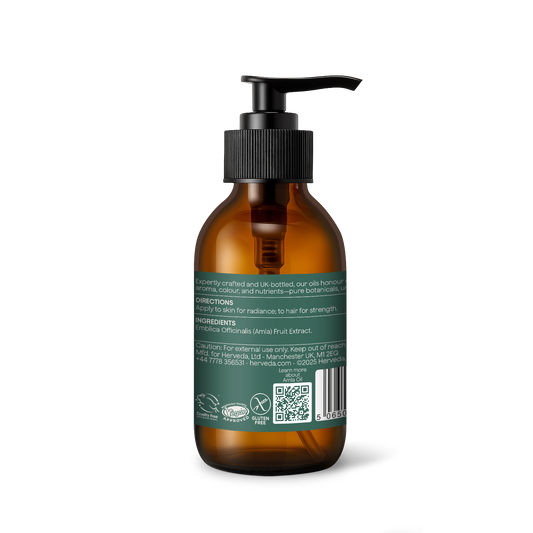
The Power of Amla
Amla is not simply a “superfruit.”
In Ayurveda, it is revered as one of the most powerful Rasayana botanicals — traditionally used to strengthen, fortify and preserve vitality over time.
It forms the backbone of Triphala, one of the most respected classical formulations.
But beyond internal use, Amla has long been applied to the scalp and hair.
It is valued for:
• Supporting strong, resilient strands
• Maintaining depth of natural colour
• Encouraging density and shine
• Cooling and balancing excess heat at the scalp
This is not surface conditioning.
It is root-level care.
The Scalp Massage Tool
Formed from natural wood and set with smooth Kansa metal nodes, this traditional tool is designed for controlled, rhythmic pressure across the scalp.
Used with oil, it supports circulation and helps distribute product evenly from root to length. The rounded metal tips allow movement without scratching or abrasion — firm, but measured.
Consistent use helps:
• Release built-up tension in the scalp
• Improve oil penetration through massage
• Stimulate the surface of the scalp
• Support long-term scalp vitality
The movement should be steady.
Circular.
Deliberate.
Unhurried.
This is not force.
It is repetition.
The Ritual
Ayurvedic Hair & Scalp Massage
-
Warm 1–2 teaspoons of Amla Oil between your palms.
-
Apply directly to the scalp — section by section.
-
Use fingertips first. Slow circular pressure.
-
Then introduce the massage tool.
-
Move in small rotations across the scalp. Do not drag.
-
Spend 5–10 minutes covering the entire head.
-
Leave for at least 30 minutes — or overnight.
-
Wash gently with a mild cleanser.
Repeat 1–2 times weekly.
Consistency builds strength.
Ayurvedic Heritage
Oil massage of the head — traditionally known as Shiro Abhyanga — has been practised for centuries.
It is believed to:
• Support strong hair growth
• Calm excess heat
• Relieve tension in the scalp and temples
• Maintain clarity and vitality
In classical households, scalp oiling was not occasional.
It was routine.
Amla was one of the most trusted botanicals for this purpose.
Not because it was fashionable.
But because it endured.