If February feels harder on your skin, your sleep, or your nervous system — you’re not imagining it.
The air is dry. The wind is sharp. The light is thinner. Internally, many people notice the same shift: lighter sleep, increased sensitivity, subtle anxiety, tighter skin.
In Ayurveda, this pattern is called Vata.
Not a personality.
Not a label.
A principle of movement.
And in late winter, it rises.
Vata Is a Pattern in Nature — Not Just in You
Ayurveda doesn’t separate the body from the environment.
The same forces shaping the season shape us.
You see Vata in:
• Wind moving through dry leaves
• Seasonal transitions
• The space before sunrise
• The quiet before sleep
• Periods of change and uncertainty
Vata increases during:
• Autumn and late winter
• 2–6am and 2–6pm
• Travel, overstimulation, irregular routines
• Times of hormonal transition
• Later stages of life, when the body becomes lighter and drier
When movement increases in nature, movement increases in us.
That is the central insight.
What Vata Governs in the Body
Vata is the principle of movement within physiology.
It governs:
• The nervous system
• Breath and circulation
• Elimination
• Skin hydration
• Mental activity
• Sleep rhythm
Its qualities are:
Light
Cold
Dry
Mobile
Irregular
When those qualities accumulate, symptoms appear.
How Modern Life Amplifies Vata
You don’t need extreme weather to experience imbalance.
Modern life increases Vata daily:
• Central heating dries the skin and airways
• Screens overstimulate the nervous system
• Multitasking fragments attention
• Travel disrupts rhythm
• Skipping meals destabilizes digestion
Vata is movement without containment.
Most of us live in constant motion.
How Vata Shows Up
When Vata rises, you may notice:
• Skin becoming dry or more lined
• Sleep becoming lighter or interrupted
• A wired-but-tired feeling
• Increased worry or overthinking
• Gas or irregular digestion
• Cold hands and feet
• Creativity rising — but focus drifting
In balance, Vata gives:
Creativity
Adaptability
Sensitivity
Enthusiasm
Out of balance, it leads to volatility and depletion.
The Skin–Nervous System Connection
In Ayurveda, the skin and nervous system are closely linked.
Both are governed by Vata.
When the nervous system becomes overstimulated, skin loses moisture and resilience.
When sleep becomes fragmented, repair declines.
When digestion becomes irregular, hydration suffers.
Dryness inside eventually shows outside.
Which is why topical care alone rarely solves Vata imbalance.
Stability must be internal and external.
Time Matters: The Vata Hours
Between 2–6am and 2–6pm, Vata naturally rises.
If you wake at 3am with racing thoughts — that is a Vata hour.
If your energy dips and becomes scattered mid-afternoon — that is Vata moving.
Understanding this changes how you respond.
You don’t fight it.
You anchor it.
Life Stage & Vata
As we age, the body naturally becomes lighter and drier.
Ayurveda describes later adulthood as a Vata-dominant phase of life.
This does not mean decline.
It means the need for more nourishment, rhythm, and containment.
Women in midlife often experience Vata shifts through:
• Sleep changes
• Skin dryness
• Increased anxiety
• Digestive irregularity
The season outside and the season of life can overlap.
When they do, Vata rises quickly.
How to Stabilise Vata
Vata is calmed not by intensity, but by steadiness.
Five levers matter most:
1. Warmth
Warm meals. Warm oils. Warm showers. Warm clothing.
2. Oil
Daily oil massage. Nourishing fats. Skin barrier support.
3. Rhythm
Regular meals. Consistent bedtime. Predictable routines.
4. Nourishment
Cooked, grounding meals. Not extremes. Not restriction.
5. Structural Support
When Vata is persistently elevated — especially in sleep, anxiety, or chronic dryness — deeper internal and external support may be needed.
Supporting Vata More Deeply
For those experiencing ongoing dryness, anxious sleep, or nervous system depletion:
• CalmVeda 23™ supports nervous system stability
• RestVeda 32™ anchors fragmented sleep
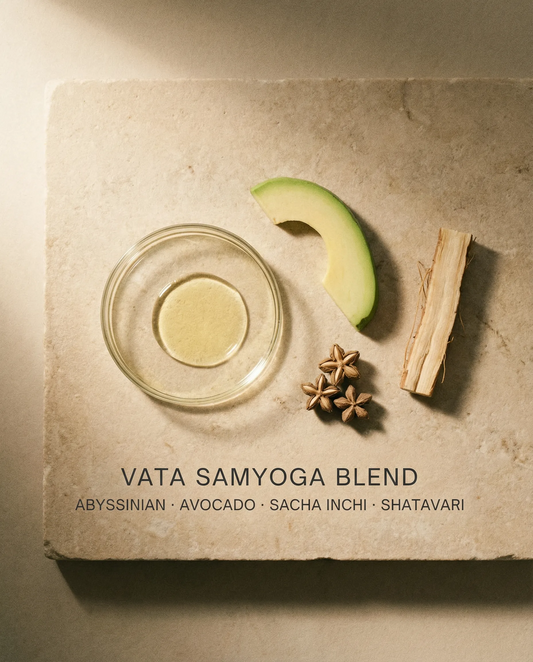
• Sanchara Glow supports Vata-prone skin
Explore The Vata Support System >
A Different Way to Think About Balance
Balance is not perfection.
It is reduced volatility.
When Vata stabilises:
Skin softens.
Sleep deepens.
Thoughts slow.
Digestion steadies.
Energy becomes consistent.
Movement remains — but it is contained.
And contained movement becomes resilience.